
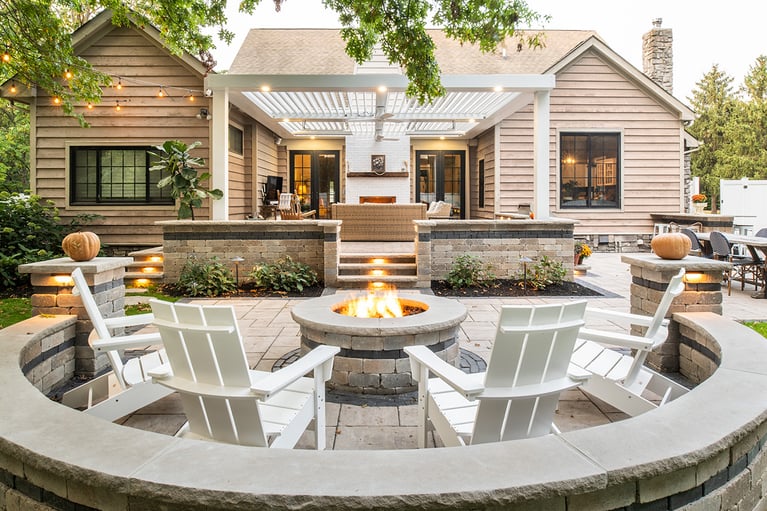
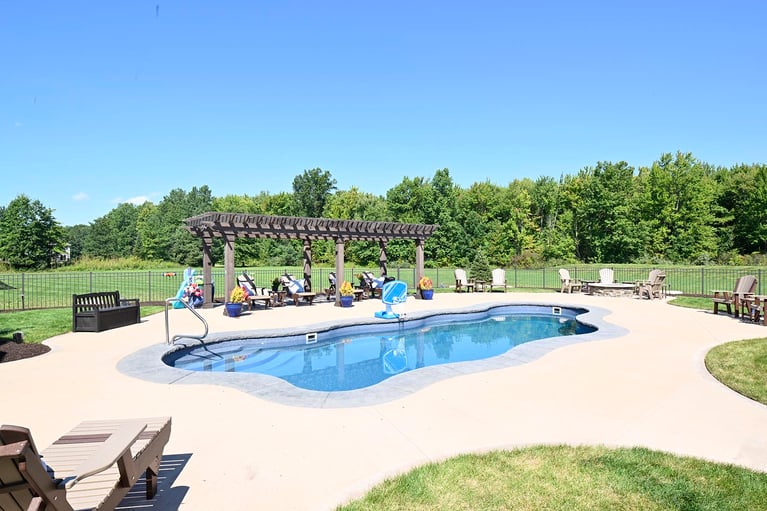
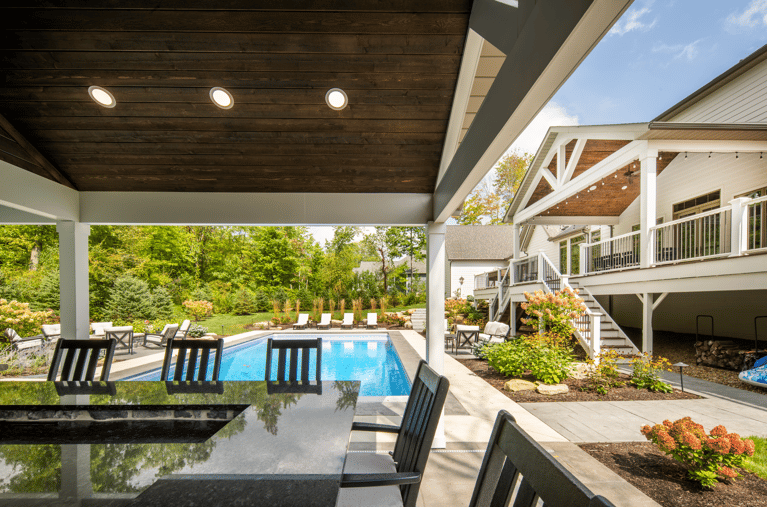
Most homeowners do not start with landscape design. They start with a feature. A patio they saw at a neighbor's house. A fire pit they found online. A pool they have been thinking about for years. The feature becomes the starting point, and the rest of the yard gets figured out along the way.
That approach works until it does not. The patio drains toward the house. The fire pit feels too close to the seating wall. The pool deck does not connect to the walkway in a way that makes sense. Each feature looks fine on its own. Together, they do not feel like a unified property.
In Cleveland and Northeast Ohio, where freeze-thaw cycles, clay soils, and dramatic seasonal shifts test every surface, the consequences of building without a plan show up fast.
Related: A Backyard Made for Slower Moments: Landscape Design & Pergola Ideas for Westlake, OH, Homes
.jpg?width=484&height=323&name=Why%20Landscape%20Design%20Is%20the%20Step%20Most%20Homeowners%20Skip%20(And%20Why%20It%20Costs%20Them).jpg)
What Landscape Design Actually Solves
A landscape design in Sheffield Village, OH, is not a drawing of where the patio goes. It is a plan that accounts for how every element on the property relates to every other element, and how all of them relate to the house, the grade, the drainage, and the way the homeowner actually uses the space.
A thorough design process addresses questions that most homeowners do not think to ask until something goes wrong:
- Where does water go when it rains, and how does the grade direct it away from the foundation, the patio, and the planting beds instead of toward them
- How does the patio connect to the house, the walkway, and the lawn in a way that feels intentional and allows natural foot traffic between zones
- What is the right scale for the fire feature, the seating area, and the plantings relative to the size of the yard and the architecture of the home
- How will the space look and function in January as well as July, and are the materials and plantings chosen for year-round performance in this climate
These are spatial, structural, and horticultural questions. They require measurements, grading analysis, soil evaluation, and an understanding of how materials perform in Northeast Ohio's conditions over time. Guessing at those answers leads to features that work in isolation but fail as a space.
Related: 5 New Landscaping Trends To Inspire Your Outdoor Space
Why the Design Phase Pays for Itself
The cost of a landscape design is a fraction of the cost of the construction it informs. And the rework it prevents, the drainage corrections, the relocated features, the replaced materials, almost always costs more than the design would have.
A design gives the homeowner clarity before the first dollar is spent. It shows the finished space in context, identifies problems before they become surprises, and creates a plan that can be built in phases if the budget requires it, with each phase connecting to the next because the whole was designed from the beginning.
Start With the Plan
Your outdoor space should feel like it belongs together. The patio, the plantings, the lighting, the fire feature, the walkway, all of it should read as one design, not a collection of additions made over time.
Related: Expert Lawn Care & Landscaping in Bay Village, OH: Transforming Outdoor Living